고정 헤더 영역
상세 컨텐츠
본문
대화할 때, 마스크를 썼을 때 문득 느껴지는 불쾌한 입 냄새 때문에 고민이신가요?
나만 느끼는 것 같아도 상대방은 이미 알고 있을지 모른다는 생각에 자신감이 뚝 떨어지기도 하죠.
사실 입 냄새(구취)는 매우 흔한 문제이며, 대부분은 간단한 습관 개선으로 해결할 수 있습니다.
연구에 따르면 입 냄새의 80~90%는 입안의 문제에서 비롯된다고 합니다 (Memon et al., 2022; Khounganian et al., 2023; Li et al., 2023; Bollen & Beikler, 2012).
오늘은 지긋지긋한 입 냄새의 근본적인 원인부터 확실한 해결 방법, 그리고 냄새 종류로 추측해보는 건강 신호까지! 과학적 근거를 바탕으로 속 시원하게 알려드릴게요.
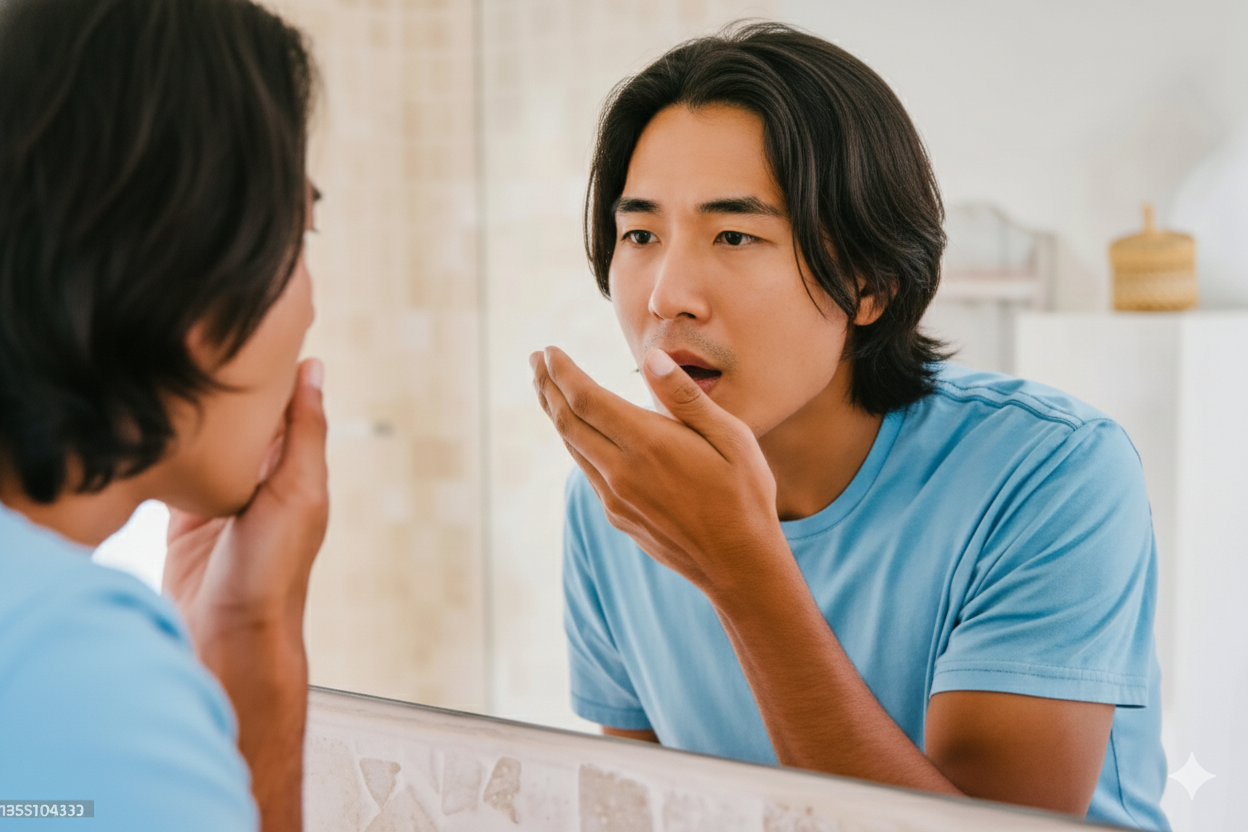
1. 내 입 냄새, 도대체 왜 나는 걸까요?
입 냄새의 원인은 크게 '입안의 문제'와 '몸속의 문제'로 나눌 수 있습니다.
압도적인 원인, 바로 '입 속' 문제
- 혀의 백태(설태): 주범은 바로 여기! 입 냄새의 가장 큰 원인은 바로 혀에 끼는 하얀 혹은 누런 이물질, '설태'입니다 (Memon et al., 2022; De Geest et al., 2016). 특히 혀 안쪽 깊숙한 곳에 음식물 찌꺼기와 세균이 쌓여 불쾌한 냄새를 만드는 주요 물질인 휘발성 황화합물(VSCs)을 만들어냅니다 (Tonzetich, 1977; Suzuki et al., 2019).
- 잇몸병 (치주질환): 잇몸에 염증이 생기거나, 치아와 잇몸 사이의 틈(치주 포켓)이 깊어지면 세균이 번식하기 좋은 환경이 되어 냄새가 심해집니다 (De Geest et al., 2016; Memon et al., 2022).
- 부족한 구강 관리: 양치질이나 치실 사용이 부족하면 입안에 세균과 음식물 찌꺼기가 그대로 남아 냄새를 유발합니다 (Memon et al., 2022; Khounganian et al., 2023). 또한, 침 분비가 줄어 입이 마르면 세균이 더 활발하게 증식해 입 냄새가 악화될 수 있습니다 (Bollen & Beikler, 2012; Scully & Greenman, 2012).
이 외에도 충치, 낡은 보철물이나 의치 등도 냄새의 원인이 될 수 있습니다 (Kapoor et al., 2016; Bollen & Beikler, 2012).
칫솔질만으로 부족한 구강 관리 나에게 맞는 추가 관리 방법은?
구강세정기, 치실, 치간칫솔, 나에겐 뭐가 맞을까?
매일 꼼꼼히 양치하는데도 충치가 생기고 잇몸이 붓는다면, 혹시 '치아 사이'를 놓치고 있는 건 아닐까요?칫솔질만으로는 치아 사이의 플라그를 완벽하게 제거하기 어렵습니다.그래서 많은 분
tuche-0407.tistory.com
혹시 다른 곳이 아픈 신호? '몸 속' 문제
10~20%의 경우는 입이 아닌 다른 신체 기관의 문제일 수 있습니다.
- 이비인후과 질환: 축농증(부비동염), 편도결석, 비염 등 (Memon et al., 2022; Rasouli et al., 2024)
- 소화기 질환: 역류성 식도염, 위장 장애 등 (Memon et al., 2022; Li et al., 2023)
- 전신 질환: 당뇨병, 간이나 신장 질환, 특정 대사질환 (Preti et al., 1992; Rasouli et al., 2024)
- 생활 습관: 흡연, 음주, 그리고 마늘이나 양파 같은 특정 음식 섭취 (Kapoor et al., 2016; Khounganian et al., 2023)
2. 지긋지긋한 입 냄새, 확실하게 없애는 법
원인을 알았으니 이제 해결 방법을 알아볼까요? 가장 중요한 것은 단연 올바른 구강 위생 관리입니다.
가장 효과적인 방법: '혀 클리닝'
양치질만으로는 부족합니다. 입 냄새 감소에 가장 효과적인 방법은 바로 '혀 클리너'나 칫솔로 혀를 닦아주는 것입니다. 특히 아침에 일어났을 때 나는 입 냄새를 줄이는 데 매우 효과적입니다 (Faveri et al., 2006). 치실 사용을 함께하면 냄새 유발 물질을 더욱 효과적으로 줄일 수 있습니다 (Faveri et al., 2006).
보조 요법: 가글과 최신 트렌드 '프로바이오틱스'
클로르헥시딘, 에센셜 오일 등이 포함된 구강세정제(가글)는 플라그와 잇몸 염증, 구취를 줄이는 데 도움을 줄 수 있습니다
(Takenaka et al., 2018; Carvalho et al., 2004).
최근에는 입 냄새를 줄여주는 유익균, 즉 구강 프로바이오틱스(예: Weissella cibaria) 섭취가 입 냄새 유발 물질을 줄이고 심리적 만족도까지 높인다는 연구 결과도 있습니다 (Han et al., 2023; Sahu & Sethi, 2024). 녹차나 프로폴리스 같은 천연 성분도 일부 효과가 보고되었습니다 (De Faveri et al., 2021; Manouchehri, 2023).
프로바이오틱스의 효과가 궁금하다면?
구강유산균(프로바이오틱스), 정말 효과 있을까?
"입냄새 잡는 유산균", "잇몸 건강 지켜주는 유산균"… 요즘 '구강유산균'이라고도 불리는 구강 프로바이오틱스 제품, 광고나 후기를 통해 많이 접해보셨을 겁니다. 먹으면 입안이 상쾌해지고 잇
tuche-0407.tistory.com
잠깐! 만약 꾸준히 관리하는데도 입 냄새가 사라지지 않는다면, 이는 다른 질환의 신호일 수 있으므로 반드시 치과나 관련 전문의의 진료를 받아보는 것이 중요합니다 (Nagraj et al., 2019; Bollen & Beikler, 2012).
3. 냄새로 알아보는 원인 힌트, 혹시 내 입 냄새는?
특정 냄새는 원인 질환을 추측하는 데 작은 힌트가 될 수 있습니다. 하지만 냄새만으로 자가 진단은 금물! 정확한 진단은 꼭 전문가에게 받아야 합니다.
- 달걀 썩는 냄새: 입안의 세균이 단백질을 분해할 때 주로 발생 (Whittle et al., 2007; Sharma et al., 2023)
- 생선 비린내: 드물지만 '트라이메틸아민뇨증'이라는 유전적 대사질환을 의심해 볼 수 있음 (Whittle et al., 2007)
- 달콤한 과일 냄새: 당뇨병성 케톤산증의 신호일 수 있음 (Sharma et al., 2023)
- 코에서 냄새가 날 때: 축농증 등 이비인후과 질환일 가능성 (Rosenberg, 1996)
정확한 원인 파악을 위해서는 병원에서 문진, 구강 검사, 구취 측정기 등 전문적인 평가가 필요합니다 (Laleman & Dadamio, 2025; Rosenberg, 1996).
결론: 자신 있는 숨결의 시작은 '혀' 관리부터!
입 냄새의 대부분은 입안 문제, 그중에서도 '설태'가 핵심 원인입니다. 오늘부터 양치 후 혀 안쪽까지 부드럽게 닦아주는 습관을 들여보세요. 이것만으로도 훨씬 상쾌해진 숨결을 느낄 수 있을 겁니다.
만약 꾸준한 노력에도 입 냄새 고민이 계속된다면, 주저하지 말고 전문가의 도움을 받아 근본적인 원인을 찾아 해결하시길 바랍니다.
[참고문헌]
Bollen, C., & Beikler, T. (2012). Halitosis: the multidisciplinary approach. International Journal of Oral Science, 4, 55 - 63. https://doi.org/10.1038/ijos.2012.39
Carvalho, M., Tabchoury, C., Cury, J., Toledo, S., & Nogueira-Filho, G. (2004). Impact of mouthrinses on morning bad breath in healthy subjects.. Journal of clinical periodontology, 31(2), 85-90. https://doi.org/10.1111/j.0303-6979.2004.00452.x
De Faveri, M., Pupio, G., Koo, H., Bueno-Silva, B., De Oliveira, K., Figueiredo, L., Rosalen, P., Hayacibara, R., & Fujimaki, M. (2021). The effect of Brazilian propolis type-3 against oral microbiota and volatile sulfur compounds in subjects with morning breath malodor. Clinical Oral Investigations, 26, 1531 - 1541. https://doi.org/10.1007/s00784-021-04125-x
De Geest, S., Laleman, I., Teughels, W., Dekeyser, C., & Quirynen, M. (2016). Periodontal diseases as a source of halitosis: a review of the evidence and treatment approaches for dentists and dental hygienists.. Periodontology 2000, 71(1), 213-27. https://doi.org/10.1111/prd.12111
Faveri, M., Hayacibara, M., Pupio, G., Cury, J., Tsuzuki, C., & Hayacibara, R. (2006). A cross-over study on the effect of various therapeutic approaches to morning breath odour.. Journal of clinical periodontology, 33(8), 555-60. https://doi.org/10.1111/j.1600-051x.2006.00955.x
Han, H., Yum, H., Cho, Y., & Kim, S. (2023). Improvement of halitosis by probiotic bacterium Weissella cibaria CMU: A randomized controlled trial. Frontiers in Microbiology, 14. https://doi.org/10.3389/fmicb.2023.1108762
Kapoor, U., Sharma, G., Juneja, M., & Nagpal, A. (2016). Halitosis: Current concepts on etiology, diagnosis and management. European Journal of Dentistry, 10, 292 - 300. https://doi.org/10.4103/1305-7456.178294
Khounganian, R., Alasmari, O., Aldosari, M., & Alghanemi, N. (2023). Causes and Management of Halitosis: A Narrative Review. Cureus, 15. https://doi.org/10.7759/cureus.43742
Laleman, I., & Dadamio, J. (2025). Current methods for halitosis diagnosis and the impact of COVID-19 pandemic: an international survey. Journal of Breath Research, 19. https://doi.org/10.1088/1752-7163/ada6f5
Li, Z., Li, J., Fu, R., Liu, J., Wen, X., & Zhang, L. (2023). Halitosis: etiology, prevention, and the role of microbiota. Clinical Oral Investigations, 27, 6383 - 6393. https://doi.org/10.1007/s00784-023-05292-9
Manouchehri, N. (2023). Most Important Medicinal Plants with Anti-Halitosis Property: an Overview. Journal of Biochemicals and Phytomedicine. https://doi.org/10.34172/jbp.2023.1
Memon, M., Memon, H., , F., Fahad, S., Siddiqui, A., Lee, K., Tahir, M., & Yousaf, Z. (2022). The aetiology and associations of halitosis: a systematic review.. Oral diseases. https://doi.org/10.1111/odi.14172
Nagraj, K., Eachempati, P., Uma, E., Singh, V., Ismail, N., & Varghese, E. (2019). Interventions for managing halitosis.. The Cochrane database of systematic reviews, 12, CD012213. https://doi.org/10.1002/14651858.cd012213.pub2
Preti, G., Preti, G., Clark, L., Clark, L., Cowart, B., Feldman, R., Feldman, R., Lowry, L., Weber, E., & Young, I. (1992). Non-oral etiologies of oral malodor and altered chemosensation.. Journal of periodontology, 63(9), 790-6. https://doi.org/10.1902/jop.1992.63.9.790
Rasouli, A., Momand, S., Anwari, M., & Shafiq, A. (2024). RHINOLARYNGOLOGICAL AND SYSTEMIC CAUSES OF HALITOSIS: A MINI-REVIEW. Interdisciplinary Approaches to Medicine. https://doi.org/10.26577/appmed2024v5a1-06
Rosenberg, M. (1996). Clinical assessment of bad breath: current concepts.. Journal of the American Dental Association, 127(4), 475-82. https://doi.org/10.14219/jada.archive.1996.0239
Sahu, V., & Sethi, R. (2024). Preprobiotics and Ayurvedic Ingredients for Halitosis Treatment: A Review. Asian Journal of Pharmaceutical Research. https://doi.org/10.52711/2231-5691.2024.00014
Scully, C., & Greenman, J. (2012). Halitology (breath odour: aetiopathogenesis and management).. Oral diseases, 18(4), 333-45. https://doi.org/10.1111/j.1601-0825.2011.01890.x
Sharma, A., Kumar, R., & Varadwaj, P. (2023). Smelling the Disease: Diagnostic Potential of Breath Analysis. Molecular Diagnosis & Therapy, 27, 321 - 347. https://doi.org/10.1007/s40291-023-00640-7
Sterer, N., & Rosenberg, M. (2011). Breath Odors: Origin, Diagnosis, and Management. Breath Odors. https://doi.org/10.1007/978-3-030-44731-1
Suzuki, N., Yoneda, M., Takeshita, T., Hirofuji, T., & Hanioka, T. (2019). Induction and inhibition of oral malodor.. Molecular oral microbiology, 34(3), 85-96. https://doi.org/10.1111/omi.12259
Takenaka, S., Ohsumi, T., & Noiri, Y. (2018). Evidence-based strategy for dental biofilms: Current evidence of mouthwashes on dental biofilm and gingivitis. The Japanese Dental Science Review, 55, 33 - 40. https://doi.org/10.1016/j.jdsr.2018.07.001
Tonzetich, J. (1977). Production and origin of oral malodor: a review of mechanisms and methods of analysis.. Journal of periodontology, 48(1), 13-20. https://doi.org/10.1902/jop.1977.48.1.13
Whittle, C., Fakharzadeh, S., Eades, J., & Preti, G. (2007). Human Breath Odors and Their Use in Diagnosis. Annals of the New York Academy of Sciences, 1098. https://doi.org/10.1196/annals.1384.011
'우리 가족 구강관리' 카테고리의 다른 글
| 치약, 치아미백제 과대광고? 식약처 '의약품 안전나라'로 1분 만에 확인하는 법 (0) | 2025.11.17 |
|---|---|
| 칫솔질, '이 방법'으로 잡아야 플라그 제거 효과 UP! (0) | 2025.11.08 |
| 칫솔, 다 똑같지 않나요? 연령별 칫솔 선택이 중요한 이유 (0) | 2025.10.30 |
| 우리 아기 첫 치약, 불소 1000ppm 괜찮을까요? (0) | 2025.10.29 |
| 아이 입 냄새 원인, '이것' 때문 (0) | 2025.10.29 |


